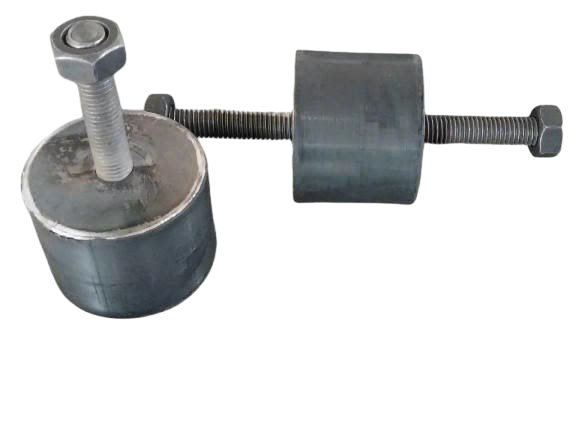
1️. Product Introduction
The Rubber Vibration Isolator with Bolt manufactured by Anh Trí Tuệ Company is a specialized product designed to absorb vibration, reduce noise, and protect industrial equipment.
The rubber component is made from NR/SBR (Natural Rubber / Styrene-Butadiene Rubber), featuring high elasticity, excellent mechanical strength, and heavy-load resistance, ensuring long-term operational stability of machinery.
This product is widely used in tobacco manufacturing plants, across multiple stages of the production line—where precision, stability, and smooth operation of equipment are critical.
2️. Key Features
- Effective Vibration and Noise Reduction:
Absorbs and isolates mechanical oscillations, preventing vibration transmission to the floor or adjacent machines.
- High Durability and Load Capacity:
NR/SBR material offers excellent wear resistance, compressive strength, and minimal deformation during long-term operation.
- Stable in Factory Environments:
Performs reliably under the temperature, humidity, and dust conditions typical of tobacco manufacturing plants.
- Flexible Installation:
The bolt-type design allows direct mounting onto machine bases, support frames, or foundations, and easy replacement during maintenance.
3️. Application in the Tobacco Manufacturing Industry
In tobacco production lines, equipment operates continuously with numerous rotating, cutting, vibrating, and conveying components.
Rubber Vibration Isolator with Bolt (NR/SBR) is installed at various stages to ensure that machines operate smoothly, precisely, and with improved stability.
🔹 Stage 1 – Leaf Preprocessing and Cleaning
- Equipment: Vibrating screens and impurity separators generate strong, continuous vibrations.
- Function: The anti-vibration rubber absorbs high-frequency oscillations, reduces noise, stabilizes the screen frame, and prevents weld cracking.
🔹 Stage 2 – Leaf Cutting and Blending
- Equipment: Leaf cutters, mixers, and flavoring machines operate at high rotational speeds.
- Function: NR/SBR rubber minimizes mechanical vibration, ensures precise cutting, reduces shaft misalignment, and decreases bearing fatigue.
🔹 Stage 3 – Cigarette Rod Formation and Filter Assembly
- Equipment: Cigarette makers and filter assemblers require high-speed and high-precision motion.
- Function: Dampens vibration of the entire machine body, stabilizes rod-forming speed, reduces gear wear, and extends servo motor lifespan.
🔹 Stage 4 – Packaging and Conveyor Systems
- Equipment: Packaging machines and conveyor belts operate continuously with rapid start-stop cycles.
- Function: The anti-vibration rubber eliminates transmitted vibration, stabilizes packaging modules, ensures smooth conveyor operation, and minimizes product misalignment and packaging noise.
Overall, installation of Rubber Vibration Isolator with Bolt throughout each stage allows the entire tobacco production line to operate more quietly, experience fewer mechanical failures, and maintain consistent product quality.
4️. Manufacturing Advantages by Anh Trí Tuệ
- Custom fabrication according to machine specifications, including size, height, and bolt thread (M8–M16).
- Strict control of hardness and elasticity to meet vibration requirements for each application.
- Optional outer layer of oil-resistant or chemical-resistant rubber for installation near motors, bearings, or maintenance areas.
- On-site technical support for installation, vibration testing, and optimization of mounting positions for each machine.
The Rubber Vibration Isolator with Bolt provides an effective solution for stabilizing production lines, reducing vibration and noise, and extending equipment lifespan in modern tobacco manufacturing plants.
This product is manufactured in Vietnam by Anh Trí Tuệ Company and is supplied consistently to multiple factories across the national tobacco industry.