Custom FKM Gaskets – Precision Manufacturing Based on Samples for Critical Sealing (ATT)
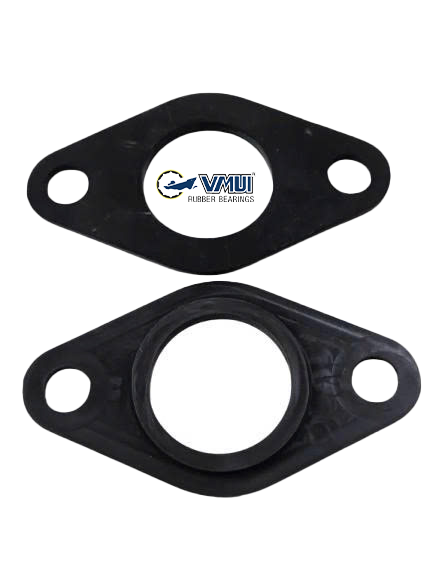
FKM Gaskets are specialized sealing components designed for flange joints, where sealing force is applied via bolts and the mating surfaces are prone to leakage due to vibration, thermal expansion, or surface imperfections. Unlike standard "off-the-shelf" gaskets, many industrial assemblies utilize custom flange designs (unique bore sizes, bolt patterns, mounting tabs, or sealing beads). Therefore, the most effective solution is often custom fabrication based on physical samples or engineering drawings.
At Anh Tri Tue (ATT), FKM flange gaskets are manufactured to strictly adhere to customer-provided samples. Furthermore, we can optimize the material formulation, hardness, and sealing surface structure to enhance sealing integrity, extend service life, and minimize leakage risks during operation.
Why Choose FKM for Flange Gaskets?
FKM (commonly known as Viton or Fluoroelastomer) is the material of choice for "challenging" joints where standard rubber grades would suffer from rapid aging or excessive swelling.
FKM is typically selected when the system operates under one or more of the following conditions:
- Media Exposure: Direct contact with mineral oils, lubricants, greases, fuels, oil vapors, or sludge.
- High Temperatures & Thermal Cycling: Environments where extreme heat or fluctuating temperatures would cause standard rubber to harden, crack, or suffer from compression set.
- Long-Term Sealing Integrity: Applications requiring resistance to compression set (permanent deformation) under prolonged load.
- Chemical Environments: Exposure to industrial gases or chemical vapors (specific compatibility assessments available upon request).
Operational Issues Solved by ATT FKM Flange Gaskets
- Mitigating Flange Joint Leakage
Leakage often occurs due to:
- Imperfect flange surfaces (scratches or high roughness).
- Uneven bolt torque distribution (common in 2-bolt flanges).
- Loss of clamping force due to vibration.
Solution: Our FKM gaskets offer superior elasticity and recovery, allowing them to "compensate" for micro-imperfections and maintain stable contact pressure.
- Thermal Stability During Temperature Fluctuations
Heating and cooling cycles cause materials to expand and contract. If the gasket lacks thermal resistance, it effectively becomes brittle or deforms, leading to leakage after a few cycles.
Solution: FKM is engineered for environments with heat accumulation or continuous high-temperature operation.
- Preventing Swelling and Material Degradation
Common rubber compounds can swell rapidly when exposed to oils or fuels, altering dimensions and reducing clamping force.
Solution: FKM significantly minimizes volume swell, ensuring dimensional stability in fuel and oil environments.
Customizable Gasket Geometries
Depending on the sample provided and the operating conditions, ATT can manufacture various technical configurations:
- Flat Gaskets
- Application: Ideal for well-machined flanges with sufficient and even bolt torque.
- Pros: Easy to manufacture, simple installation, orientation-independent.
- Profiled Gaskets (With Sealing Beads/Raised Ribs)
- Application: The raised bead concentrates clamping pressure onto a specific "sealing line," enhancing sealability in low-torque assemblies or on imperfect surfaces.
- Pros: Highly effective for vibrating assemblies or compact 2-bolt flanges.
- Gaskets with Locating Tabs/Collars
- Application: Designs featuring tabs or collars to assist in centering and prevent shifting during installation.
- Pros: Reduces the risk of "gasket pinch" or misalignment during bolt tightening.
ATT replicates the exact geometry of your sample and can propose engineering refinements (e.g., optimizing thickness or bead profile) to maximize durability.
Applications by Industry and Location
Below are common application groups for FKM flange gaskets:
- Automotive & Heavy Machinery: Intake and Oil Vapor Lines
- Flange connections on air intake manifolds requiring airtight seals to prevent flow deviations.
- Joints within the engine bay exposed to blow-by gases, fuel vapors, or oil mist.
- Equipment: Forklifts, generators, construction machinery, and diesel/gasoline engines.
- Benefit: Prevents oil mess in the engine compartment and ensures stable engine operation under vibration.
- EGR Systems & Medium-Temperature Air Ducts
- Flange connections between valves, pipes, and adapters in Exhaust Gas Recirculation (EGR) systems requiring anti-aging properties.
- Note: For areas immediately adjacent to extreme heat sources, metal/graphite gaskets may be required. However, for downstream sections (post-cooler), FKM is the superior choice for flexibility.
- Benefit: Reduces gas leakage and soot accumulation at joints; extends maintenance intervals.
- Oil & Gas / Industrial Hydraulics
- Flange connections on lubrication lines, oil return lines, fuel systems, or compressed air lines containing oil mist.
- Auxiliary assemblies: Pumps, filtration units, and manifolds with compact flange designs.
- Benefit: Resists swelling and leakage after prolonged hot operation; outlasts standard NBR rubber.
- Chemical Processing (Application Specific)
- Systems containing solvent vapors or mild chemicals where FKM offers good chemical resistance.
- Benefit: Reduces the risk of rapid degradation and failure caused by incompatible materials.
- MRO & Retrofitting (Maintenance, Repair, Operations)
- Scenario: Older machinery, imported equipment, or modified assemblies where standard part numbers are obsolete or unavailable.
- Solution: Reverse engineering from samples allows for rapid replacement and inventory standardization.
- Benefit: Minimizes downtime and ensures consistent quality across replacement batches.
ATT Manufacturing Process: From Sample to Finished Product
Our workflow is designed for efficiency and precision:
- Sample Reception: We receive the physical sample, technical drawing, or 3D scan data.
- Material Specification: Confirmation of FKM grade based on oil/fuel/heat resistance requirements.
- Technical Definition: Finalizing hardness (Shore A), sealing structure (flat vs. beaded), and tolerance criteria.
- Production: Flexible manufacturing from small trial batches to full mass production.
- Quality Control: Rigorous inspection of dimensions, uniformity, surface finish, and hardness before delivery.